
You're avoiding fun
Because the shine of getting what you want is hard to take in

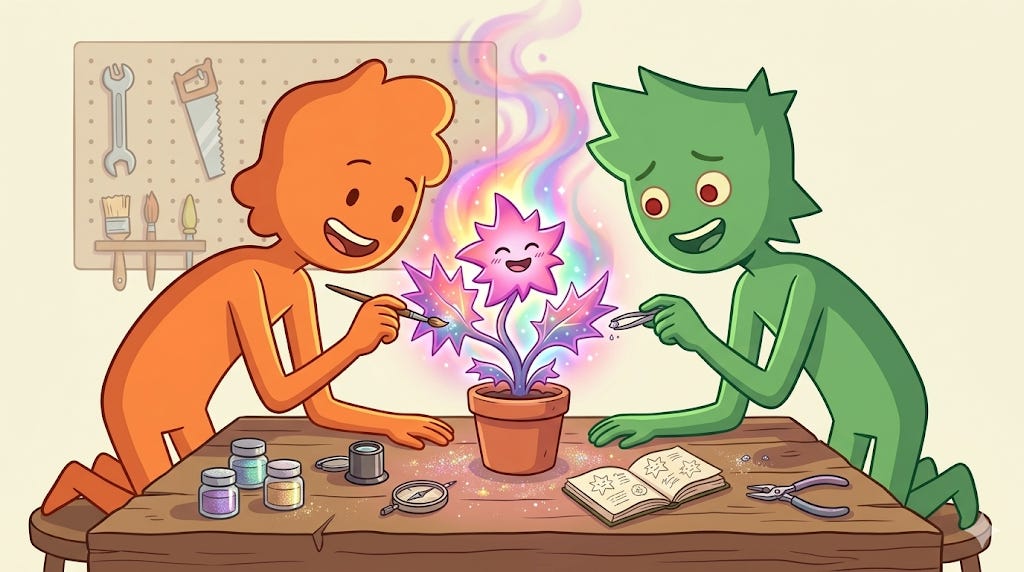
I do producing sessions with creative founders. You bring the project you’re most excited about and/or stuck on and we work it together. Not coaching exactly. More like jamming out. We open up the project, ask what it wants and follow the thread of aliveness.
Last week I jammed with Zakk. He’s building an autonomous agent called Adam, modeled on the story of Frankenstein’s monster. But instead of terrorizing villagers, this one’s reading and organizing the whole of the western philosophical canon to uncover novel lines of thought. Formal prose, literary voice, a whole 19th-century aesthetic. It’s strange and beautiful.
Zakk has a big creative engine. He’s working five projects. Four of them are moving. This one — the one he calls the coolest, the most interesting, the one where the heart of his company lives — hadn’t been touched in over a month.
~~~
I asked him what happens when he sits down to work on it.
Not writer’s block, he said. Not confusion. Something more elaborate. A cascade of decisions. Which model should I use? Should I pay for the premium one or run it locally? Do I put it on the Mac Mini or a server? Which credit card? Should I scrap the whole thing and start over?
Every question is reasonable. He’s a technical founder. These are real decisions. But he’s been making real decisions on his other projects just fine. It’s this one, the one closest to him, where the decisions multiply into a frozen stew.
I said: this is a really creative way not to do the thing you’re most excited about.
He laughed, because he already knew.
~~~
I see this pattern often (in myself and in clients). The big creative engine, the thing that makes someone an extraordinary builder, doesn’t distinguish between building toward and building away. It just builds. Point it at the scary project and it produces the work. Point it away and it produces something else. Something that doesn’t carry the weight of your actual desire.
We generate alternatives. New tools. New frameworks. New side projects. A whole system for organizing the work. The engine doesn’t care what it makes. But we do. And the gap between “I can build anything” and “I can’t build this” — this specific thing, the one I care about most — that gap is where the avoidance lives.
The sneaky thing is often the avoidance is productive. A creative person in avoidance doesn’t scroll their phone. They ship features on a different project. They feel competent and busy and like they’re making progress, because they are. Just not on the thing.
~~~
We got the project booted up. Took a while, Docker crashing, models going down, the infrastructure fighting back like it was grumpy at us. Then we were in.
Zakk had been trying to get the agent to speak in the voice of Frankenstein’s monster. This formal, literary, 19th-century prose. It kept reverting to standard AI after a couple messages. Flat. Helpful. Dead.
So we started directing it together. Zakk driving, me tossing in framing. Give it to me again. Too modern. We’re basically at a Ren fair — don’t break character. He’d edit the response, push it back, shape it again. I’d suggest a move. Stay in character even when doing admin, rewrite the whole identity in the period voice. He’d run with it, twist it, make it his.
The vibe shifted. We weren’t configuring a system anymore. We were playing. The voice work was alive. Zakk was laughing. The agent was responding. We’d gone from troubleshooting to jamming, and the project that hadn’t been touched in a month was suddenly the most fun thing either of us had done all week.
This is what the avoidance was protecting him from. Not failure. Not complexity. This. The aliveness of the thing when he actually sits down with it. The intensity of uninhibited caring.
~~~
What keeps us from the project isn’t a lack of discipline or a missing plan. It’s that the project is so alive. The excitement is bubbling over, we feel it every time someone asks us about it, every time it jumps out at us in the shower. We reach for the easier work, because sometimes the most alive thing is too much fun to hold solo.
I didn’t fix Zakk’s project. We made room for the project to express itself. The voice work, the directing, the jamming — that was Zakk and his project reconnecting. The project had things it wanted to say. It had a voice it wanted to speak in. It had directions it wanted to go. When we stopped troubleshooting and started playing, the project took the lead.
Producing is making room for the project to show up as itself, in whatever way it needs to, so that the person making it can befriend its shine. When a project knows it can express freely, the work flows. The decisions that were paralyzing an hour ago become obvious, because the relationship is alive again and the project is being heard.
A producer holds this space. My job in the room is not to have the answers but to keep the channel open between you and the work. To notice when you’re building away and gently point you back toward what’s calling.
Happening in the studio:
Our first Incubator just kicked off. 11 people are joining us for six weeks to give their early projects a boost of love
The Project Assessment (free) - people are really enjoying this one. We created a 10-minute agent conversation that helps you check-in with your project